Why Do Smart People Stay in Jobs They Hate?
Oct 18, 2026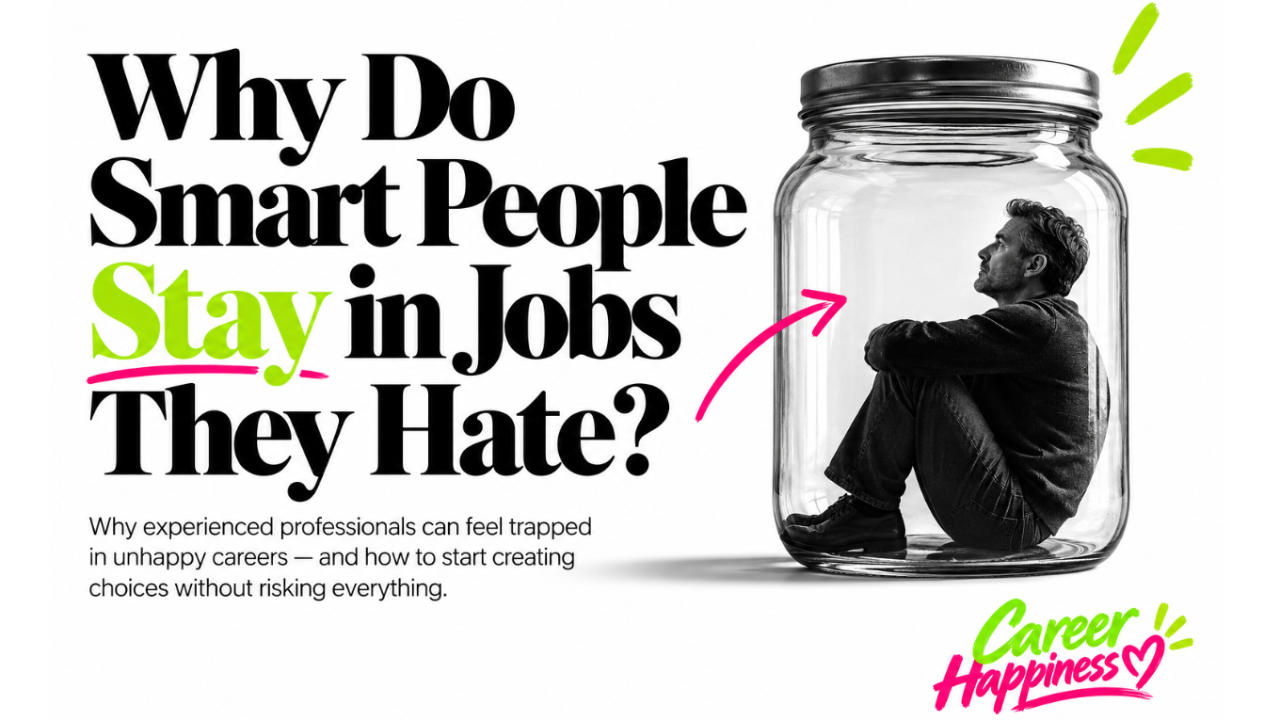
Why experienced professionals can feel trapped in unhappy careers and how to start creating choices without risking everything.
One of the strangest things I've noticed throughout my career is that some of the smartest, most capable people stay in jobs they hate.
Not for weeks or months.
Sometimes for years.
These are talented, experienced professionals. People with valuable skills, impressive achievements and, on paper, plenty to offer.
Yet they remain in roles that frustrate them, drain their energy or leave them feeling deeply unfulfilled.
And I think one of the most interesting questions we can ask is why.
After all, if you're unhappy at work, why not simply leave?
The answer, of course, is that it's rarely that simple.
The invisible safety valve
I've coached people who desperately wanted to change their working lives.
We've discussed their ambitions, explored opportunities and identified practical steps they could take.
They've reached the point where they're ready to act.
Then something happens.
They stop.
Perhaps they'll give it another three months. Perhaps something will change internally. Perhaps the right opportunity will come along without them having to do anything.
It's almost as though an invisible safety valve kicks in.
And I've come to understand why.
For someone with a mortgage, school fees, family commitments or other financial responsibilities, changing jobs isn't simply a career decision.
It's a decision that could affect their entire household.
The fear of losing a secure income can easily become more powerful than the desire to find something better.
Sometimes waiting is absolutely the right decision.
But sometimes people aren't making a deliberate decision to wait. They're postponing the same decision repeatedly because the alternative feels frightening.
And that's where years can disappear.
When security becomes a trap
The older we get, the more complicated career decisions can become.
At 25, changing direction might feel exciting.
At 45, with a mortgage, children, pension considerations and financial commitments, it can feel like an enormous gamble.
We gradually build our lives around our income.
Our homes, lifestyles and responsibilities become connected to the salary we've worked hard to achieve.
And sometimes, without realising it, we create a situation where leaving feels impossible.
The question changes.
It's no longer simply, "What would I love to do?"
It becomes:
"What can I afford to risk?"
That's a perfectly reasonable question.
Financial security matters. Responsibilities matter. And telling someone to follow their dreams without considering either isn't particularly helpful.
But there's another question worth asking.
What might it cost you to stay exactly where you are?
Not just financially.
In confidence, energy, development and the enjoyment you get from your working life.
Because staying has consequences too.
Have you forgotten how capable you are?
Something else I've noticed is that experienced professionals can become remarkably good at underestimating themselves.
They've spent years developing skills, solving problems, managing relationships and navigating difficult situations.
But because those capabilities have become familiar, they stop recognising their value.
They assume everybody can do what they do.
Or they worry that employers will prefer someone younger, cheaper or with more recent experience.
Age-related barriers and recruitment challenges can be real. It's important not to dismiss them.
But neither should we automatically assume that our opportunities have disappeared.
One of the most useful exercises I encourage people to undertake is to look carefully at their experience.
What problems can you solve?
What skills have you developed?
What achievements are you proud of?
And how might those capabilities be valuable in a different role, team or organisation?
Sometimes we become so accustomed to what we're capable of that we forget somebody else might find those skills incredibly valuable.
The challenge is recognising them, communicating them and understanding where they might take us.
The comfort of the familiar
Not every reason for staying is financial.
Sometimes it's simply familiarity.
You know the organisation. You understand the systems. You've built relationships and established a reputation.
Even when you're frustrated, you know how to navigate your working day.
Starting somewhere new means uncertainty.
New colleagues. New expectations. New technology. The possibility of rejection.
And when your confidence has already taken a knock, that uncertainty can feel exhausting.
There's also the question of identity.
For many experienced professionals, their career has become a significant part of who they are.
They're the manager, the specialist, the director or the person everyone turns to when something goes wrong.
Changing direction can mean questioning an identity they've spent years building.
So perhaps it's unsurprising that some people choose the security of what they know.
The problem comes when familiarity becomes the only reason they stay.
The career-changing opportunity I nearly missed
I know from personal experience that changing your career doesn't always mean leaving your employer.
Earlier in my career, I was working as a business analyst when an opportunity arose to move into training.
I applied for a maternity-cover role.
And I was rejected.
It would have been easy to accept that decision and carry on doing what I'd always done.
But I went back, continued to demonstrate my interest and eventually secured an opportunity.
That move completely changed the direction of my career.
I developed new qualifications, learned new skills and discovered opportunities that ultimately took me well beyond training itself.
Looking back, it wasn't simply a change of job.
It was the beginning of a different professional direction.
And it happened because I was prepared to explore an opportunity within the organisation I already worked for.
I don't share that story because every rejection will eventually turn into an opportunity. It won't.
I share it because we sometimes underestimate how many possible directions our careers could take.
And occasionally, an opportunity that initially appears closed isn't necessarily closed forever.
What if leaving isn't your only option?
When someone tells me they're unhappy but cannot afford to leave their job, my first response isn't to encourage them to resign.
It's to explore their situation.
What exactly is making them unhappy?
Is it the work itself? Their manager? A lack of development? The working environment? Or something outside work that's affecting how they feel?
Then we can start considering what's possible.
Could they explore a different role within their organisation?
Could they get involved in another project, undertake a secondment or spend time shadowing someone in a different department?
Could they develop a skill that would create opportunities further down the line?
Sometimes a different manager, team or set of responsibilities can completely change someone's experience of work.
And if internal opportunities genuinely don't exist, they can still begin preparing for a future move.
The important thing is not to confuse staying in your current job with having to remain in your current situation forever.
Creating options before making decisions
If you know you're unhappy but aren't prepared to leave for another twelve months, you can still make meaningful progress.
Start by understanding your value.
Look at job descriptions for roles that interest you. Compare the skills and experience employers are seeking with what you already offer.
Identify any gaps and consider how you might address them.
Then start building relationships.
Reconnect with former colleagues. Talk to people working in areas that interest you. Explore mentoring, coaching and development opportunities.
If appropriate, communicate your ambitions within your existing organisation. Managers aren't mind readers, and they may not know you're interested in doing something different.
Finally, consider what would make a future decision less financially frightening.
Could you build some savings? Reduce a particular commitment? Explore additional income or develop skills that might create more opportunities?
Not everyone will have the financial capacity to do those things immediately.
But understanding your position can help you make more informed decisions.
You don't have to change everything tomorrow.
You can start preparing today.
The cost of standing still
One of the most difficult situations I've encountered is someone who doesn't hate their job quite enough to leave but doesn't enjoy it enough to feel fulfilled.
They're respected. They're reasonably well paid. They like their colleagues.
But they're no longer growing.
And because nothing is dramatically wrong, it's easy to keep postponing the bigger questions.
Another three months.
Another year.
Perhaps something will change.
Sometimes it does.
But if you've been waiting for the same opportunity for years and nothing has happened, it's worth examining whether your expectations are realistic.
You can't control every organisational decision.
You can, however, take greater responsibility for understanding your options and preparing yourself to pursue them.
And that begins with something much less dramatic than handing in your notice.
Honesty.
What is genuinely keeping you where you are?
What could you realistically change?
And what might happen if you do nothing?
Sometimes the first step towards a happier career isn't leaving your job.
It's realising you may have more choices than you thought.
A question for you
If you've been thinking about making a career change but haven't taken the next step, what's holding you back?
Is it financial security, confidence, responsibility, familiarity or something else?
And what's one small thing you could do this month to create another option?
Career Happiness helps experienced professionals rediscover what makes work meaningful and develop the clarity, confidence and practical support to shape their next career chapter.
Lorem ipsum dolor sit amet, consectetur adipiscing elit. Cras sed sapien quam. Sed dapibus est id enim facilisis, at posuere turpis adipiscing. Quisque sit amet dui dui.
Stay connected with news and updates!
Join our mailing list to receive the latest news and updates from our team.
Don't worry, your information will not be shared.
We hate SPAM. We will never sell your information, for any reason.