Why Burnout Isn't Always About Working Too Much
Oct 19, 2026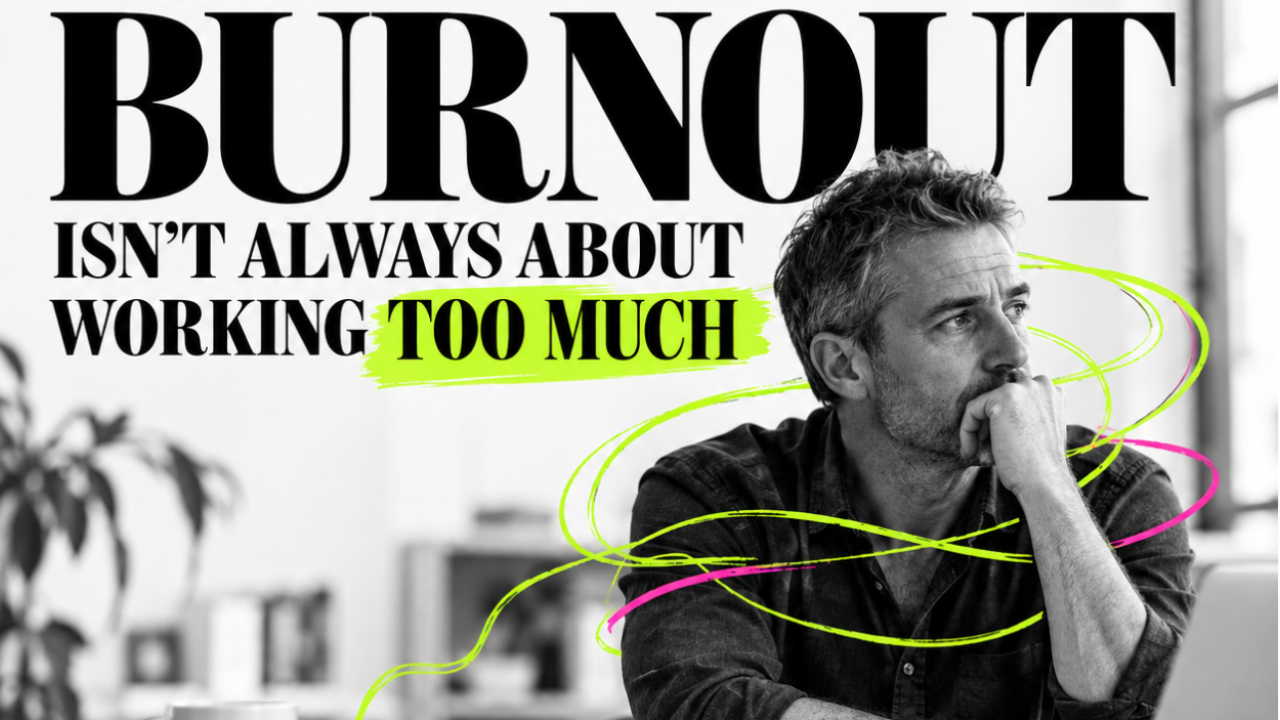
Sometimes reducing the workload helps. Sometimes we need to understand what the work is costing us and why.
Have you ever gone on holiday feeling completely exhausted by work?
For the first few days, you can barely switch off.
Then something starts to happen.
You sleep better. Your shoulders drop. Work feels further away. You start thinking about other things.
Maybe you even start feeling like yourself again.
Then the holiday ends.
You go back to work and, within a few days, you're right back where you started.
Same exhaustion.
Same frustration.
Same Sunday evening feeling.
If that sounds familiar, it might be worth asking a slightly different question.
What if you're not simply tired from working too much?
What if something about the way you're working isn't working for you anymore?
Burnout isn't always about volume
We often talk about burnout as though it's a simple equation.
Too much work + not enough rest = burnout.
And sometimes workload absolutely is the problem.
But our experience of work is more complicated than the number of hours we put in.
You can feel exhausted by constantly having to prove yourself.
By not feeling listened to.
By being micromanaged when you need autonomy.
By doing work that doesn't use your strengths.
By trying to fit into a culture where you don't feel particularly comfortable being yourself.
Even masking — constantly adjusting yourself to fit an environment — can take energy.
And sometimes what looks like work-related exhaustion isn't entirely about work at all.
There may be things happening at home too.
Children. Ageing parents. Relationships. Finances. Health worries. Life.
That's why I think we have to be careful about immediately deciding what burnout means for someone.
Instead, we need to get under the bonnet.
What's actually going on?
One of the most useful things a good manager can do is notice when somebody isn't quite themselves.
Not diagnose them.
Notice them.
Perhaps someone who normally contributes in meetings has become quiet.
Maybe there's more sighing.
More frustration.
Less energy.
Perhaps they're reacting differently when another piece of work lands on their desk.
Sometimes the change is subtle.
That's where the relationship between a manager and an employee becomes so important.
Because a genuine:
“You don't seem quite yourself lately. How are things?”
can open a very different conversation from:
“How are you getting on with that project?”
And trust matters enormously.
If people don't feel safe enough to tell you what's really going on, you'll probably only discover there's a problem when it becomes impossible to ignore.
The problem with being reliable
There's another pattern I've seen during my career.
The capable person gets more work.
Why?
Because they'll get it done.
They're dependable.
They don't complain.
They say yes.
So another task comes their way.
Then another.
Eventually, they might be picking up work from colleagues. Sometimes they're even absorbing things their manager should probably be doing.
And because the work keeps getting completed, everything can look fine from the outside.
But it isn't necessarily fine for the person doing it.
Work starts creeping into evenings.
Then weekends.
They feel guilty when they're working because they're not spending time with their family.
And guilty when they're with their family because they're thinking about the work they haven't finished.
That's where responsibility has to work both ways.
As individuals, sometimes we need to get better at saying:
“I can take that on, but something else will need to move.”
But managers also need to ask themselves whether they're rewarding reliability with an ever-increasing workload.
Getting the work done matters.
But at what cost?
Sometimes it's about fit
I've experienced periods in my own career when work became draining not simply because I was busy, but because I didn't feel heard.
There have been times when I didn't feel my skills, experience or perspective were really being listened to.
I've also worked with people whose communication or management style was very different from mine.
Nobody necessarily has to be the villain in that situation.
Sometimes two ways of working simply don't connect particularly well.
But when that happens day after day, it can take energy.
That's why I think it's useful to look beyond the question:
“How much work have I got?”
and ask:
“What about this work is draining me?”
Those are very different questions.
Try the holiday test
Think about your last proper break from work.
What happened to your energy while you were away?
What were you thinking about once you'd had a few days to decompress?
And, perhaps most importantly:
How did you feel when you went back?
A holiday isn't a diagnostic test, and feeling reluctant to return to work doesn't automatically mean there's a fundamental problem.
But patterns are worth paying attention to.
If you repeatedly feel better away from work and quickly return to the same state when you're back, it's reasonable to become curious about why.
Otherwise it's surprisingly easy to get back on the hamster wheel.
Three months pass.
Then six.
Then a year.
And perhaps you're sitting on the same beach twelve months later, cocktail in hand, having exactly the same conversation with yourself.
Only now you're another year further down the road.
Get under the bonnet
If work is leaving you persistently drained, don't immediately jump to:
“I need to quit.”
But don't automatically settle for:
“I just need to push through.”
Instead, investigate.
What's actually changed?
Is the workload genuinely unsustainable?
Is something happening outside work that's reducing your capacity?
Do you feel heard?
Are you using your strengths?
How is your relationship with your manager?
Do you have enough autonomy?
Have your priorities changed?
Are you doing work that still matters to you?
What have you been tolerating because changing it feels difficult?
And how long has this pattern actually been going on?
Sometimes the answer might be rest.
Sometimes it might be boundaries.
Sometimes it's an honest conversation with a manager.
It could be changing responsibilities, asking for support, getting some development, moving teams or exploring a different role.
And sometimes persistent exhaustion or changes in your physical or mental health need proper support beyond a career conversation.
The important thing is not to assume every problem has the same solution.
Burnout isn't a character flaw
Being exhausted doesn't mean you've somehow become less capable.
And resilience shouldn't mean endlessly absorbing whatever work or life throws at you.
Sometimes exhaustion is telling us that something needs attention.
That doesn't automatically mean handing in your notice.
It means getting curious enough to understand what's happening before another six months disappears.
Because perhaps the goal isn't simply to become better at tolerating work that isn't working for you.
Perhaps it's to understand what needs to change.
Burnout isn't always failure. Sometimes it's feedback.
And feedback is most useful when we actually do something with it.
Lorem ipsum dolor sit amet, consectetur adipiscing elit. Cras sed sapien quam. Sed dapibus est id enim facilisis, at posuere turpis adipiscing. Quisque sit amet dui dui.
Stay connected with news and updates!
Join our mailing list to receive the latest news and updates from our team.
Don't worry, your information will not be shared.
We hate SPAM. We will never sell your information, for any reason.